

Access doesn’t end with admission. That’s something I didn’t fully understand until my first year at the University of Virginia, when I was asked if this was the place for me.
Coming into college as a first-generation and low-income student, I had high expectations at a university like Virginia. College for me meant leaving the fear of housing displacement, food insecurity, and poverty.
In high school, I grew up living with the consequences of teen “parents” who weren’t ready. Relying on government subsidies like SNAP and working two jobs to sustain staying in school.
But over the past year, I started to realize that admission is only one step.
Stepping into Grounds, I began to see that long histories of privilege and wealth shape the University of Virginia, like many other elite universities. With many of the students coming from Northern Virginia or out of state, their pedigree can be as valuable as a resume.
I remember the first day of classes, looking at a syllabus and realizing how many classes required a textbook. The many times I would have to retell the most vulnerable parts of my life to strangers.
Every textbook became another conversation. Which, in turn, became another department I had to talk to and another form I had to fill out. Another digest of my life. Before I could access the material, I first had to prove why I couldn't afford it.
Somewhere along the way, I stopped introducing myself by my interests or the questions I wanted to ask in class. Instead, I introduced myself by my financial hardship. Before I could be seen as a student, I had to be seen as someone in need.
No student should have to surrender their privacy in exchange for the opportunity to learn. Eventually, I chose to drop classes in the second semester because I wanted to be seen as a student rather than charity.
Even outside the classroom, I still felt disadvantaged. The University of Virginia promises to meet 100% of demonstrated financial need, yet many student organizations unintentionally reinforce the very inequities the University claims to address. Involvement and participation often depended on paying dues before assistance was available through the Cavalier Fund. By the time Funds could be requested, deadlines had passed, dues were already owed, or opportunities had been missed. Belonging became contingent not on interest or merit, but on whether you could afford to bridge the gap the system left behind.
In many ways, the University’s commitment to access felt performative. UVA could cite emergency funds, the Cavalier Fund, Care and Support Services, financial aid, and guides for low-income students as evidence of its support. Yet their existence did not eliminate the barriers they were meant to address. Instead, I was often expected to navigate a maze of departments before receiving help. Essentially, each institution would acknowledge inequality without fundamentally changing the structures that produced it.
I began to realize that my college experience was not being shaped by lectures or late-night study sessions. It was being shaped by bureaucracy.
Before I attended my first class, I sat in my car at a gas station on move-in day because I couldn't afford the parking permit required to bring my belongings onto Grounds. Emails bounced between Parking & Transportation, Student Financial Services, Care and Support Services, and the Dean of Students' Office as everyone searched for a temporary solution. One office suggested an emergency loan. Another suggested increasing my cost of attendance. Another issued a three-day permit while the paperwork caught up. The day I was meant to unpack my dorm room, I was waiting for the University to decide whether I could afford to move into it.
A few months later, another email thread began. This time it wasn't about parking. It was about laundry. Speed Queen required a $10 minimum just to load a laundry card, and I simply didn't have it. I asked whether the University had any resources available. Instead, I was told that a local Baptist church might let students wash their clothes for free. During the same conversation, I was reminded to begin planning for winter break housing because, unlike many of my classmates, "going home" was never an option.
Those moments seem almost absurd when written on an email chain. Ranging from a parking permit, a load of laundry, or a place to sleep over break. None of them appear in a course catalog, yet they determined whether I could fully participate in the education I had worked so hard to earn.
The people behind those emails cared. Jackie W. searched for resources. Dave checked in whenever another obstacle appeared. Professors like David Flood advocated for me when the weight of constantly surviving began affecting my academics. My academic advisor and teacher, Laura Goldblatt, offered a place to do laundry. Dean Hall supported me throughout the process and even shared my story and One Small Chance with future students on Days on the Lawn.
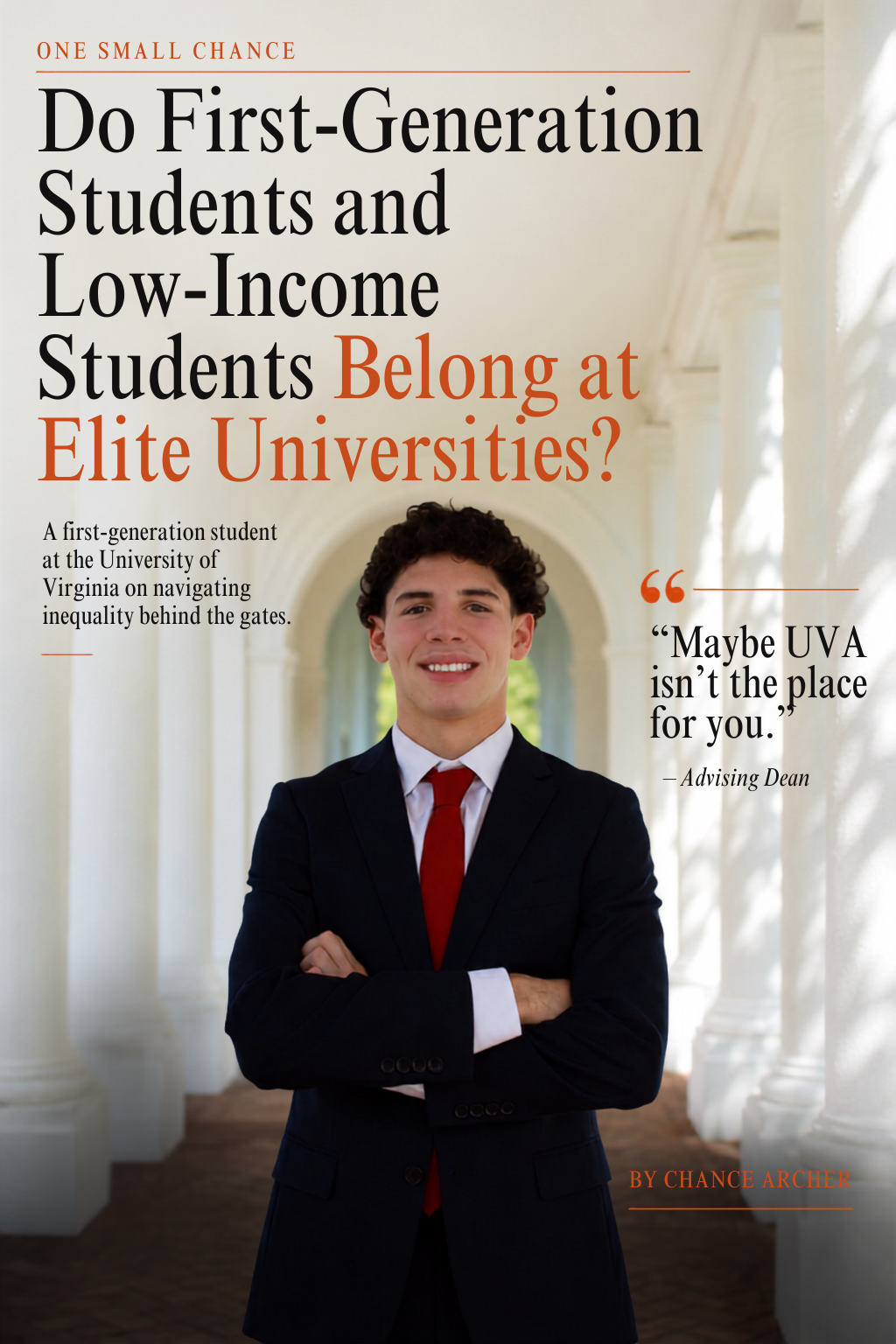
But eventually, after Professor Flood encouraged me to seek additional support, I walked into a meeting with my advising dean, Beth McClanahan, hoping someone could finally connect the dots. Instead, I was asked a question I still think about today:
"Maybe UVA isn't the place for you."
That question stayed with me because it reflected a shift I had begun to notice. Instead of asking whether the University's systems were serving students with complex financial realities, the conversation became about whether students struggling within those systems belonged at the University at all.
She denounced my problem and questioned why I was even here. It made me feel like all my work to get here, to stay here, and to continue fighting to stay here was my problem.
Afterward, I remember sitting with that conversation and realizing how often institutional “support” functioned as a temporary fix. I would go through meetings, explain my situation, receive a list of options or resources, and then return to the same constraints that brought me there in the first place.
They weren’t really solutions. They were bandages, enough to move forward on paper, but not enough to address what was actually underneath the struggle.
A lot of first-generation students and low-income students go to college to establish a life for themselves and their families.
For much of my first year, I believed the burden was mine to carry. If I couldn't afford a textbook, I needed to advocate harder. If I couldn't afford a parking permit, I needed to find another office. If I couldn't afford to do my laundry or had nowhere to go over winter break, I needed to ask another person for help.
Over time, I stopped asking what I could have done differently and started asking different questions altogether.
Why are students expected to coordinate support across five different offices while also carrying a full course load? Why are costs as simple as laundry, winter break housing, student organization dues, transportation, or textbooks treated as personal problems rather than educational barriers? If universities promise to meet 100% of demonstrated financial need, shouldn't that promise include the costs of actually participating in college?
Perhaps universities should stop expecting first-generation and low-income students to become case managers for their own success because it takes much more to stay in class than the average student. If support is scattered across financial aid, Care and Support Services, housing, advising, and countless other offices, why shouldn't every FGLI student have a centralized advocate with the authority to coordinate that support from the moment they arrive?
These are not questions unique to my experience. These are questions many first-generation and low-income students ask themselves. From the many focus groups I’ve participated in, zeroing in on the FGLI experience, this has been the repeated theme. We celebrate access through admissions statistics and financial aid packages, but far less attention is paid to what happens after students arrive.
Perhaps the question was never whether I belonged at the University of Virginia.
Perhaps the better question is whether institutions built around assumptions of financial stability are truly designed for students whose greatest obstacle is not getting admitted, but staying, participating, and belonging once they get there.
Access doesn't end with admission. It begins there.
